 Save to Pinterest
 I still remember the evening I first attempted to plate like a painter rather than a cook. It was at a small dinner party where I wanted to move beyond the conventional, to create something that would make guests lean in and look twice before even tasting. That's when the concept of motion blur came to me—vegetables arranged not in neat circles, but in a kinetic flow that suggested movement itself. It felt almost architectural, arranging jewel-toned vegetables from dense clusters that gradually dissolved into scattered elements. Now, every time I create this dish, I'm transported back to that moment of culinary discovery.
I prepared this for the first time at a dinner where one guest was a food photographer. She set down her phone the moment it arrived, unable to resist capturing it from every angle. That's when I realized this dish transcends the typical appetizer—it becomes a moment, a memory, something people talk about long after the meal ends.
Ingredients
- Golden beet, thinly sliced: The sweetness of golden beets is more delicate than red varieties, providing a buttery flavor that bridges vegetables and cheese beautifully. Slice them paper-thin on a mandoline for that translucent quality that catches the light.
- Red beet, thinly sliced: The earthiness here anchors the dish, and those deep crimson tones are what make the visual pop. Don't skip the mandoline—uniform slices ensure even cooking and consistent presentation.
- Watermelon radish, thinly sliced: This is your secret weapon. The striking pink and white rings are nature's own art, and their peppery bite keeps the palate engaged. They're less common, but worth hunting for at farmers' markets.
- Persian cucumber, thinly sliced: Cool, crisp, and delicate. They have fewer seeds than standard cucumbers, giving you those perfect translucent slices that feel almost glass-like on the plate.
- Baby carrots, sliced on a bias: The bias cut extends the surface area and makes them feel more refined than straight cuts. Their natural sweetness complements the goat cheese beautifully.
- Creamy goat cheese, at room temperature: Room temperature is non-negotiable here. Cold cheese becomes rigid and won't dot gracefully. The creaminess melts slightly onto the warm vegetables, creating pockets of luxury.
- Toasted hazelnuts, roughly chopped: Toast them yourself if you can—the smell alone is worth it, and you'll taste the difference. The toasting brings out an almost chocolatey undertone that surprises people.
- Black sesame seeds: These add an umami depth and provide dramatic visual contrast against the colorful vegetables. They're more than decoration; they're flavor.
- Microgreens: Arugula or radish microgreens work best. They're peppery and delicate, adding a fresh finish without overwhelming the subtle flavors of the roots.
- Fresh dill, fronds only: The fronds are more tender than the stems and dissolve on the tongue. They whisper rather than shout.
- Extra virgin olive oil: Use one you genuinely love. This dressing is simple, so the quality of the oil is everything.
- Fresh lemon juice and honey: The acid from the lemon brings brightness, while honey adds just enough sweetness to balance the earthiness. Together, they're the bridge between all these bold flavors.
Tired of Takeout? 🥡
Get 10 meals you can make faster than delivery arrives. Seriously.
One email. No spam. Unsubscribe anytime.
Instructions
- Create your dressing first:
- Whisk together the olive oil, lemon juice, and honey in a small bowl. This is your canvas primer. As you whisk, the honey dissolves into the oil and lemon, creating an emulsion that clings to every vegetable. Taste it—adjust the seasoning with salt and pepper until it makes you smile. It should taste bright, with just a whisper of sweetness.
- Arrange your vegetables with intention:
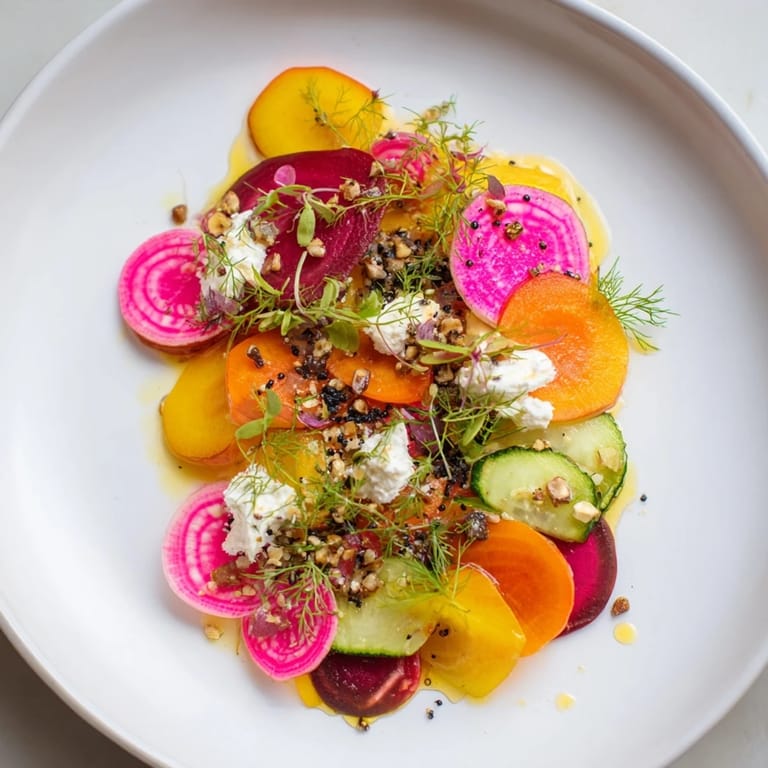
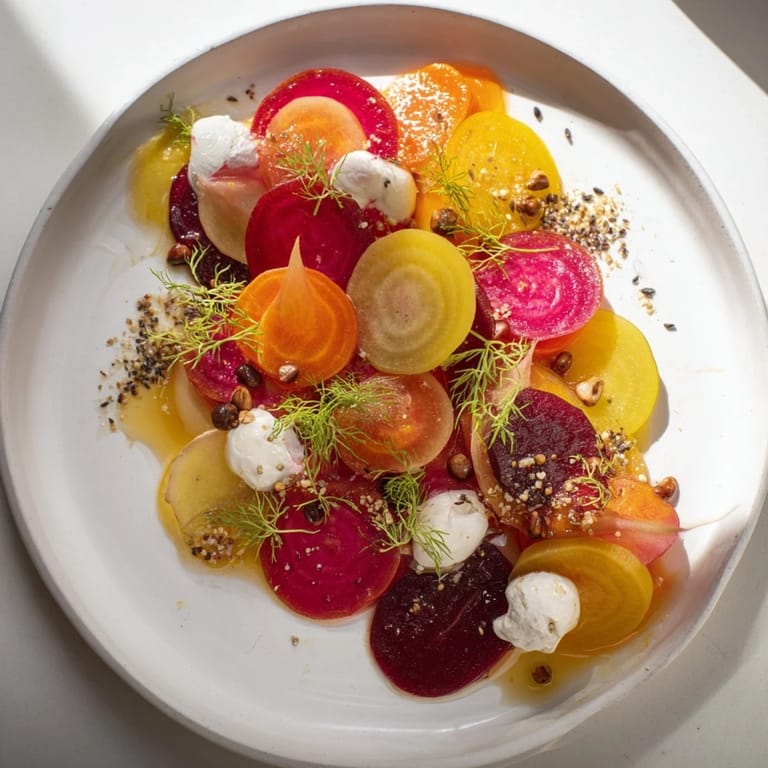
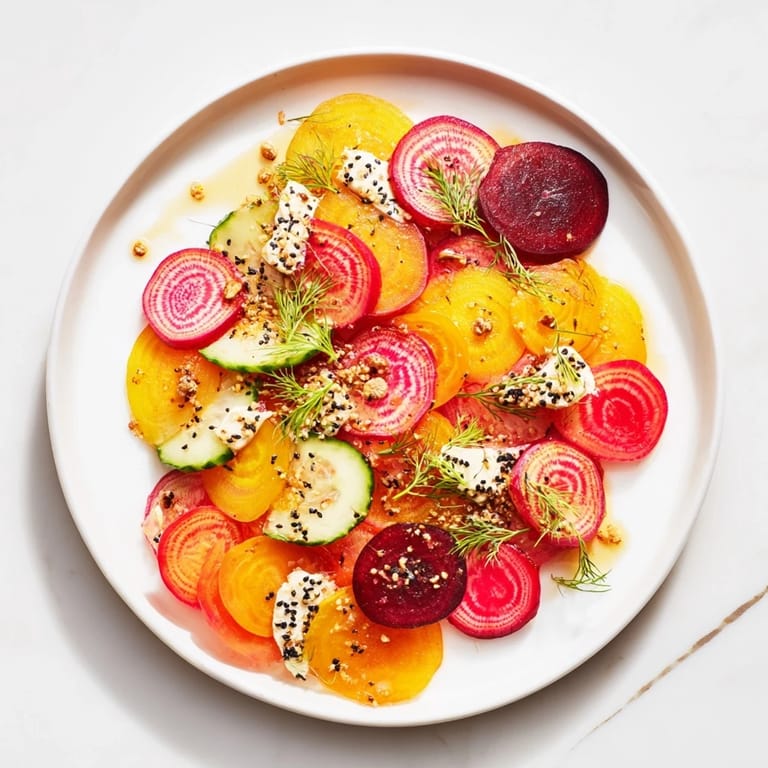
- This is where the magic happens. Start on one side of your platter with the densest cluster of vegetables—overlap your slices slightly, creating a rich tapestry of colors and textures. Golden beet, red beet, watermelon radish, cucumber, carrot—layer them so they create a visual conversation. Then, gradually space them out as you move across the plate, as if they're being pulled by invisible hands toward the opposite edge. Think of it like painting with vegetables, where the edge of your canvas gradually becomes negative space.
- Dot the goat cheese strategically:
- Using a small spoon or your fingers, place dollops of creamy goat cheese among the densest cluster. The warmth of the vegetables will soften it just slightly. As you move toward the sparser side, use fewer dollops, fading them out like the vegetables themselves. These pockets of creaminess should surprise people as they eat.
- Scatter the textural elements:
- Sprinkle the toasted hazelnuts and black sesame seeds over the arrangement, concentrating them on the dense side where they'll anchor the composition, then trailing off toward the sparse side. The nuts and seeds are your rhythm section—they add crunch and depth.
- Finish with fresh elements:
- Scatter the microgreens and dill fronds across the platter, following the same gradient—dense to sparse. The fresh herbs are delicate, so add them just before serving. They should look like they've just been placed, not wilted and tired.
- Drizzle the dressing with purpose:
- Drizzle your dressing across the entire platter, but use a lighter hand on the sparse side. The dressing should enhance the motion effect, pooling slightly in the dense areas and trailing toward the edge. Some people will mix everything together; others will eat according to the gradient. Both experiences should be delicious.
- Serve immediately:
- This dish is about freshness and visual impact. The vegetables should be crisp, the microgreens perky, and the composition intact. Bring it to the table and watch faces light up before forks even touch the plate.
 Save to Pinterest
 At another dinner, I served this to someone who spent 20 years as a pastry chef. She picked up her fork, paused, and said it reminded her why she fell in love with food—because it could be art and nourishment at the same time. In that moment, I understood that sometimes a dish is more than sustenance. It's a small conversation about beauty.
The Art of Visual Composition on a Plate
Food plating has evolved over the years, and what makes this dish special is that it rejects rigid geometry in favor of organic motion. The kinetic blur effect works because it mirrors how we actually experience food—not as static objects, but as a journey from one texture to the next. When you arrange vegetables from dense to sparse, you're giving the eye something to follow, a narrative. The color gradient naturally draws people in, creating depth and dimension on a flat surface. It's the difference between serving food and creating an experience.
Building Flavor Harmony with Simple Ingredients
The beauty of this recipe lies in its restraint. There are no complicated techniques, no obscure ingredients, yet the flavors sing together in perfect harmony. The earthiness of the beets, the slight bitterness of the microgreens, the creaminess of goat cheese, the toasted nuttiness of hazelnuts—each element has a voice. The lemon-honey dressing acts as a conductor, bringing them all into conversation. It's a masterclass in how simplicity, when executed with intention, becomes sophisticated.
Making It Yours: Variations and Seasonal Thinking
This recipe is a foundation, not a rule book. In spring, swap the root vegetables for thinly sliced radishes, asparagus ribbons, and pea shoots. Summer opens doors to stone fruits like peaches, edible flowers, and fresh mint. Fall begs for roasted squash, pomegranate seeds, and sage leaves. The principle remains—dense to sparse, color to white space, texture layering. Once you understand the architecture, you can paint with whatever vegetables are speaking to you that day.
- For a vegan version, use a nut-based cheese or simply increase the hazelnuts and add crispy chickpeas for protein.
- Add thin slices of smoked salmon or trout if you're feeling pescatarian, and let the fish anchor the densest part of your composition.
- Edible flowers like pansies, nasturtiums, or borage blossoms add unexpected beauty and a delicate floral note that elevates the entire dish.
 Save to Pinterest
 This dish reminds me that cooking is storytelling, and the best stories are told with what we have on hand. Each time you make it, it tells a different story—different vegetables, different hands arranging them, different people gathered around the table. That's the real beauty.
Recipe Q&A
- → How can I achieve the kinetic motion effect?
Arrange the vegetable slices densely on one side and gradually space them out toward the other edge to create a fading motion blur effect visually.
- → Can the goat cheese be substituted?
Yes, a plant-based cheese alternative can be used for a vegan variation without compromising the creamy texture.
- → What nuts complement this dish best?
Toasted hazelnuts bring a rich, crunchy contrast, while black sesame seeds add subtle nuttiness and visual interest.
- → Is this dish served cold or warm?
It is best served immediately at room temperature to maintain freshness and the visual impact of the arrangement.
- → What are some suggested beverage pairings?
Crisp Sauvignon Blanc or a dry sparkling wine beautifully complement the fresh, vibrant flavors.